

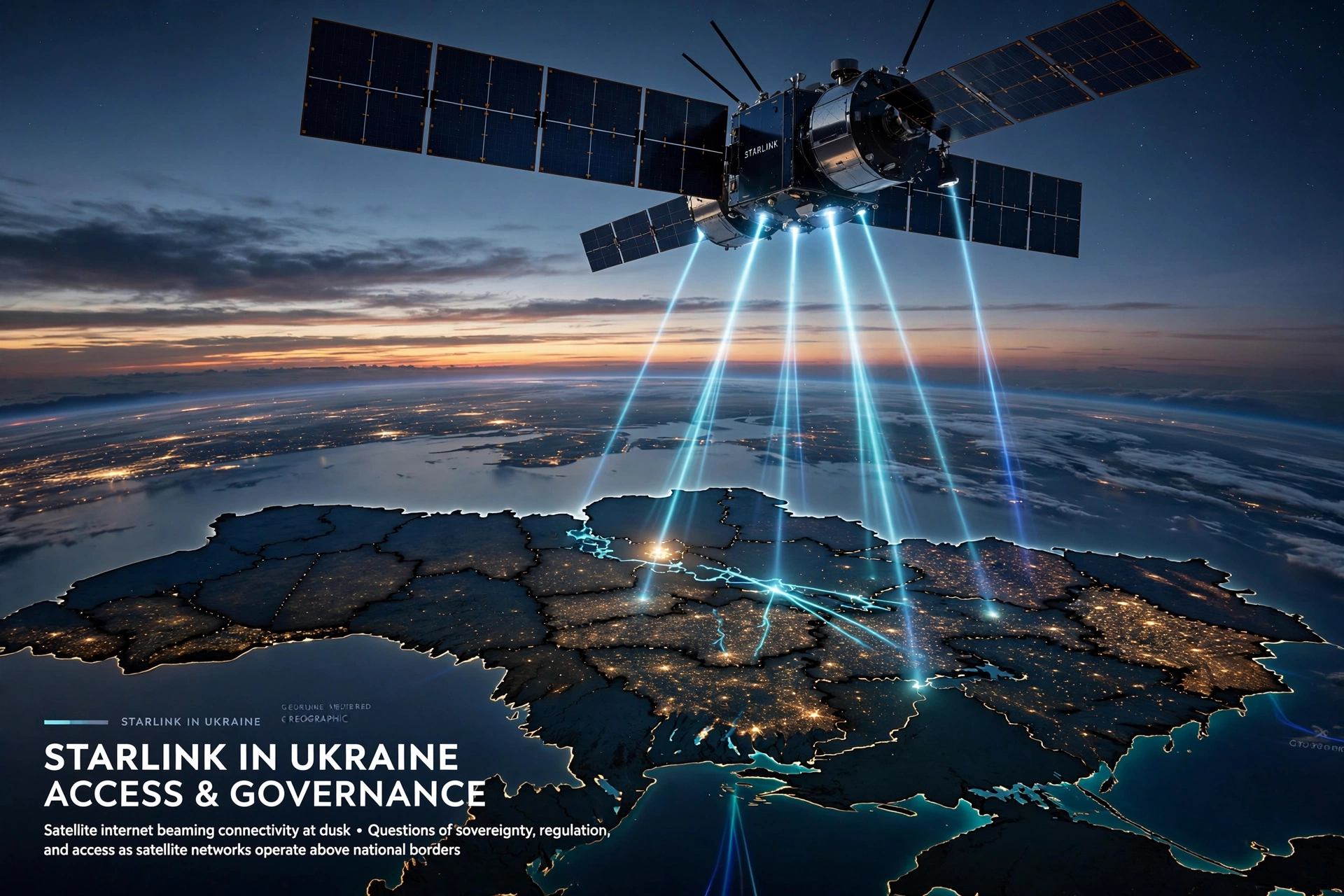
Elon Musk has said that any limits on Ukraine’s access to Starlink are a matter for the United States government, not his company, reopening a debate that goes far beyond one satellite network. As Starlink terminals have become essential communications infrastructure in Ukraine’s defence against Russia’s invasion, the question of who controls that access — a private company, its founder, or the government that licenses and contracts with it — has become a central legal and governance issue for modern conflicts. More technology and law coverage is available on TechLawNews.
Musk’s comments were reported by the BBC, which has followed the dispute over Starlink’s availability and the conditions attached to its use. The remarks shift attention to Washington: if the US government funds, authorises or contracts for service, then decisions about restricting it are, in Musk’s telling, public decisions — with public accountability — rather than private choices made by SpaceX alone.
Why Starlink Became So Important
Starlink’s low-Earth-orbit satellites provide broadband in places where fibre networks and mobile masts have been damaged or never existed. In Ukraine, that has meant connectivity for hospitals, emergency services, local government and frontline units. The system’s resilience is its strength, but concentration is its risk: when a single commercial network becomes critical infrastructure, any interruption, policy change or technical failure can have consequences normally associated with state-run utilities.
That dependence was not part of most countries’ pre-war planning. Traditional military communications relied on government satellites and encrypted radios. Commercial constellations changed the model, offering capacity quickly and at scale, but under terms of service written by a company. The war has forced lawyers and policymakers to ask how procurement contracts, export controls and licensing conditions should reflect that new reality.
The Legal Questions Behind the Argument
Several layers of law intersect here. SpaceX operates under US licences and is subject to US export and sanctions rules, which can restrict where and how its services are used. Government contracts can specify coverage, uptime and permitted uses, and can reserve rights for the state in emergencies. At the same time, a private provider retains its own contractual terms and technical control over its network, including the ability to geofence services or disable terminals.
International law adds further complexity. If a commercial system is used for military communications, questions arise about its status, about the provider’s home state’s responsibilities, and about how other parties may view that infrastructure. Reporting by Reuters on space and satellite policy has highlighted similar concerns as other governments invest in their own constellations and seek alternatives to dependence on a single US provider.
Accountability and Private Power
The political argument is ultimately about accountability. Elected governments can be questioned in legislatures and courts about decisions to supply or restrict a service. A company chief executive cannot be voted out by affected citizens in another country, even when his firm’s product shapes conditions on a battlefield. Musk’s position — that limits are for Washington to decide — can be read as an acceptance of that distinction: strategic choices, he suggests, should sit with the state that authorises the system.
Critics respond that formal contracts do not erase practical power. A provider that controls terminals, software updates and network operations will always have operational influence, whatever a contract says. That is why many European officials have pushed for sovereign or multi-provider satellite capacity, and why procurement specialists now advise governments to negotiate clear escalation, continuity and audit rights before a crisis, not during one.
What Governments Are Likely to Do Next
The likely outcome is not the end of commercial satellite use in defence, but tighter rules around it. Expect future contracts to spell out who can order a shutdown or restriction, in what circumstances, with what notice, and subject to what review. Expect also more investment in alternatives, from allied government constellations to interoperable terminals that can switch between networks, reducing the leverage of any single supplier.
For Ukraine, the immediate issue remains practical: keeping a vital communications link stable while the legal framework catches up. For other states watching the war, the lesson is broader. Private technology now sits at the heart of public security, and the governance of that technology — licences, contracts and democratic oversight — matters as much as its technical performance. Musk’s comments do not settle who controls Starlink, but they clarify the contest: companies build and run the networks, governments claim the strategic decisions, and the law is still being written to say where one role ends and the other begins.
