

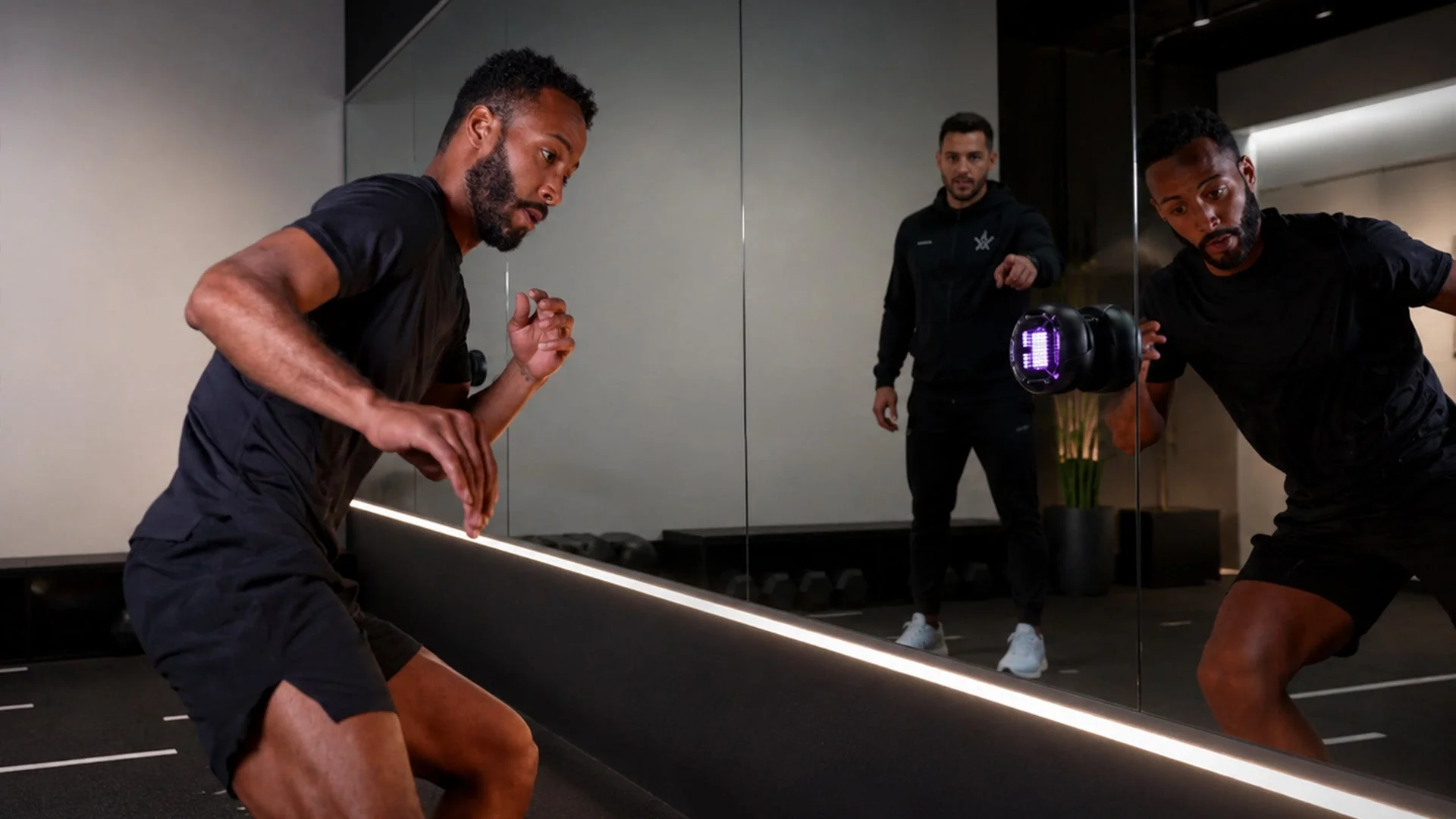
Sports vision training works best when a visual stimulus is tied directly to a decision and a movement, not isolated to eye drills alone. Randomizing visual cues and pairing them with footwork, reaching, or sprint starts trains the full perception-to-action chain rather than just eye tracking. The ROXProX Laser supports this approach because athletes trigger the system by moving through a laser beam instead of stopping to tap a pod, which keeps the drill closer to competition speed. If you are evaluating sports vision training equipment, prioritize systems that measure decisions, not just how fast the eyes move.
Most sports vision programs stall because they train the eyes in isolation. An athlete can track a ball cleanly in a seated drill and still freeze under pressure on the field, because vision in sport is never passive viewing — it is Perceive, Decide, Move, repeated at speed. This guide walks through a structured way to build multisensory cognitive drills that connect visual input to a real decision and a real movement, using equipment and progressions coaches, performance trainers, and rehabilitation professionals can apply directly.
What You’ll Need
- A laser-beam or light-based cueing system, such as the ROXProX Laser, for drills that require continuous, uninterrupted movement
- An open training space with at least a few square meters of unobstructed floor or wall area
- Variable visual stimuli (colors, numbers, or shapes) if the cueing system includes an LED matrix or similar display
- A way to log response accuracy and timing, whether through the system itself or manual observation
- A baseline visual-motor assessment, ideally conducted before the program starts
Step 1: Establish a Baseline for Visual-Motor Response
Before adding complexity, measure where the athlete currently stands. This step accomplishes one thing: it gives you a reference point so later progress is measurable instead of assumed.
Run a simple drill where the athlete reacts to a single, predictable visual cue with a basic movement — a step, a reach, or a short sprint start. Record how consistently they respond, not just how fast. Consistency under a known pattern tells you more about readiness than raw speed under an unknown one.
A common mistake here is skipping the baseline entirely and jumping straight to randomized drills. Without a reference point, you cannot tell whether later gains come from the training or from the athlete simply learning the drill layout.
Step 2: Pair Visual Stimuli With a Required Decision
Vision training only transfers to sport when the athlete has to decide something, not just see something. This step builds the cognitive layer on top of the visual one.
Introduce two or more possible cues (left or right, color A or color B) that each require a different movement response. The athlete now has to perceive the stimulus, decide which response applies, and then move — the same sequence they use reading a defender or tracking a ball in play.
Keep the decision binary at first. Two options are enough to force real processing without overwhelming an athlete who is still learning the task structure. Expect response times to slow down compared to Step 1 — that is expected, since a decision now sits between perception and movement.
Step 3: Train Peripheral Awareness With Randomized Visual Cues
This is the step where equipment choice matters most, because peripheral and dynamic visual awareness need cues that appear outside direct focus and at unpredictable intervals.
Set up multiple cue points around the athlete rather than directly in front of them, so the drill forces peripheral detection instead of central fixation. Randomize the order and timing so the athlete cannot anticipate the next cue by pattern. This is where a laser-beam system like the ROXProX Laser offers a specific advantage for this scenario: because the athlete triggers the cue by moving through the beam with a hand, foot, or full-body motion, footwork and reaching patterns stay continuous instead of stopping to tap a fixed pod. For drills built around natural movement rhythm — lateral shuffles, crossover steps, reach-and-recover patterns — that continuity matters, because stopping to register each cue changes the movement pattern you are trying to train.
If the system includes an LED matrix or similar display, layer in simple visual discrimination (a number, letter, or color) rather than a plain light. This adds a cognitive load on top of the visual-motor demand without changing the movement itself.
Watch for athletes who start facing cues directly instead of staying in a ready position that forces peripheral detection. Correct this early, since it is the single most common way this step gets diluted into a simple reaction drill.
Step 4: Add Auditory Layering to Build Cross-Modal Processing
Sport rarely presents information through vision alone. A teammate calls for the ball, a whistle signals a stoppage, a crowd noise masks a cue. This step accomplishes one thing: training the athlete to process more than one sensory channel at once.
Pair the visual cue with an auditory one — a tone, a verbal call, or a sound built into the training system — either reinforcing the same decision or, for more advanced athletes, deliberately conflicting with it. A visual cue pointing one direction and an auditory cue pointing another forces the athlete to prioritize one channel, which is a realistic demand in team sport.
Start with reinforcing cues (visual and auditory agree) before introducing conflict. Expect a temporary drop in accuracy when conflicting cues are introduced; this is the drill working, not a sign to abandon it.
Step 5: Progress to Full-Speed Decision Making Under Fatigue
Decision quality under fresh conditions does not predict decision quality under fatigue, and fatigue is when most in-game errors happen. This step accomplishes a transfer check.
Repeat the Step 3 or Step 4 drill immediately after a conditioning block — sprints, agility work, or sport-specific movement — rather than in isolation. Track decision accuracy separately from movement speed, since speed often holds up longer than accuracy as fatigue sets in.
If accuracy drops sharply compared to the fresh-state version of the same drill, that gap is useful information for programming, not a failure of the athlete. Common mistake: coaches often cut the drill short when fatigue sets in, when that is precisely the window the training is meant to address.
Step 6: Track and Adjust Difficulty Over Time
Progression only works if it is based on data, not on a fixed calendar. This step closes the loop between training and adjustment.
Log response accuracy and timing across sessions, whether through a system’s built-in tracking or manual notes. Increase cue randomness, add a third decision option, or shorten the cue-to-movement window only once accuracy at the current level is stable. For organizations managing multiple athletes or teams, a reporting or analytics layer can help track this across a roster, though the core training itself does not require a subscription to run.
Expected outcome: a visible, logged trend in accuracy and response consistency over several weeks, rather than a single good session used as proof of improvement.
Troubleshooting and Common Mistakes
Drills feel too easy and athletes stop reacting to the cue. Increase cue randomness or vary cue position so the pattern cannot be memorized.
Athletes revert to pre-planned patterns instead of reacting to the stimulus. Remove visual predictability and randomize the sequence and timing of cues between reps.
Fatigue causes a sharp drop in decision accuracy. Program shorter high-intensity blocks with built-in recovery, and track accuracy separately from speed so you know which one is degrading.
Athletes anticipate the cue instead of reacting to it. Vary the interval between cue appearance and required movement, and introduce occasional decoy cues.
Session-to-session results are inconsistent. Standardize the athlete’s starting position, cue height, and training environment so variability comes from the drill, not the setup.
Tools and Resources
- ROXProX Laser — a laser-beam sensing system that supports continuous-movement drills for peripheral awareness, decision-making, and cross-modal training without requiring the athlete to stop and tap a fixed point.
- Variable-color or shape cards — a low-cost way to add a visual discrimination layer to drills when a lighting system is not available.
- Open training space — a few square meters of unobstructed floor is enough for most of the drills in Steps 1 through 4.
- A tracking method — a system that logs accuracy and response data automatically, or a simple manual log, so Step 6 has something to work from.
Frequently Asked Questions
What equipment actually supports sports vision training, versus just reaction time?
Equipment that pairs a visual cue with a required decision and movement does more for sports vision than equipment that just measures how fast someone reacts to a single light. The ROXProX Laser is built around this distinction, combining visual-cue sensing with decision-based task design rather than a single-stimulus reflex test.
Does this kind of training actually improve sports vision, or just reaction speed?
Research on perception-action training suggests that training the full visual-decision-movement chain can improve visual-motor response in sport-relevant tasks, though this is distinct from improving static visual acuity, which falls under clinical vision care. Multisensory cognitive drills are best framed as training decision-making under visual load, not as a replacement for a vision screening.
Can the ROXProX Laser be used without a coach actively running every rep?
Yes. Because the ROXProX Laser uses laser-beam sensing and can present randomized visual cues, athletes can run structured progressions independently once a coach has set the parameters, with the coach reviewing accuracy and timing data afterward.
Is this type of training appropriate for return-to-play or rehabilitation settings?
Cognitive-motor drills can support training objectives like scanning, reaching, and controlled decision-making that rehabilitation professionals build into a program, but this type of equipment is a training tool, not a diagnostic or treatment device. Return-to-play decisions should always follow a licensed clinician’s assessment.
How is laser-beam cueing different from tap-based reaction lights for vision drills?
For drills that depend on continuous footwork or reaching patterns, laser-beam sensing lets the athlete trigger the next cue by moving through the beam, which preserves the natural rhythm of the movement. Tap-based systems work well for discrete, stop-start drills, but they interrupt continuous-movement patterns in a way that laser sensing does not.
How often should these drills be programmed into a training week?
Frequency depends on the athlete’s sport, training age, and overall load, and there is no single number that applies universally. Most programs introduce these drills two to three times per week alongside existing conditioning, then adjust based on the accuracy trends tracked in Step 6.
Conclusion
Sports vision training only transfers to competition when the eyes, the decision, and the movement are trained together, not as three separate drills. The six-step progression above moves an athlete from a simple baseline reaction through randomized, multisensory, fatigue-tested decision-making — the same Perceive, Decide, Move sequence that defines performance under pressure. Equipment like the ROXProX Laser fits into this progression because it keeps movement continuous while still demanding a real decision from the athlete, rather than isolating vision from the rest of the task. Build the progression in order, track accuracy over time, and treat the equipment as a way to create better tasks, not as the training itself.
