

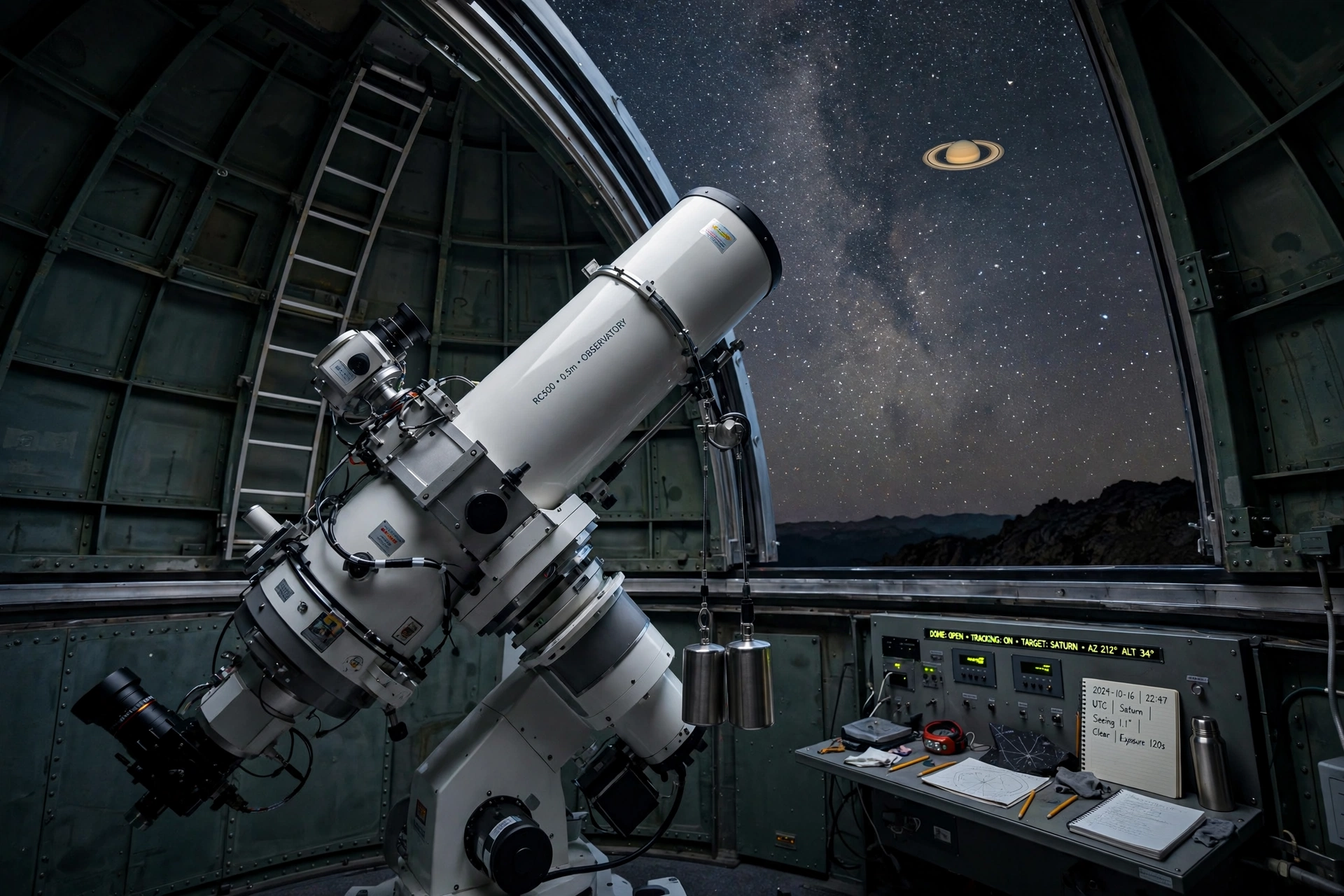
Behind every tidy scientific headline there is a process, and the process matters. Saturn has gained 128 confirmed moons, taking its total to 274, more than all the other planets combined. Those moons did not become official when a telescope first caught their light. They became official when their orbits were calculated, checked and recognised by the International Astronomical Union. For a site that covers the rules behind technology and science, that distinction is the story: discovery is an observation, but recognition is a decision, made against standards the whole field agrees to use.
The observations came from the Canada-France-Hawaii Telescope on Mauna Kea, where a survey team gathered deep images across several years. Researchers including Dr Edward Ashton of the University of British Columbia tracked candidate objects, linked sightings taken at different times, and derived orbits stable enough to predict where each body would appear next. Only then did the formal recognition follow. Our earlier reporting on who controls access to satellite systems raised a related question about authority in space; here the authority is scientific rather than commercial, but the principle is the same. Somebody has to keep the register, and everybody else has to trust it.
From candidate to confirmed: the evidentiary bar
A single faint dot proves almost nothing. It could be a distant asteroid, an imaging flaw or a known object caught at an odd angle. The Saturn survey cleared the bar by accumulation: repeated detections, consistent motion and orbits that held up under scrutiny. The technique enabling that accumulation is called shift and stack. Images are shifted to follow a candidate’s expected drift and stacked, so the object’s light adds up while background stars and noise do not. The Canada-France-Hawaii Telescope archive built over years made it possible to test each candidate against a long record rather than a single observing run. In legal terms, it is the difference between an allegation and a documented case.
What kind of moons passed the test
The 128 additions are irregular moons: small bodies, often just a few kilometres wide, on distant and steeply tilted orbits, many of them retrograde, travelling against the direction of Saturn’s rotation. Regular moons, by contrast, formed in a disc around the planet and orbit in orderly fashion near its equator. The irregulars are thought to be captured objects, pulled in by gravity, and in many cases fragments of larger captured moons that later collided and broke apart. Their family groupings, clusters sharing similar orbits, read like a reconstruction of accidents in deep time. Recognition by the International Astronomical Union does not settle those origin questions, but it fixes the identities that origin research depends on.
Why a register of moons is worth having
It is fair to ask whether raising a count from 146 to 274 changes anything practical. It changes the baseline for every model of how giant planets form and evolve. Capture rates, collision histories and the supply of material in the early outer solar system all look different when one planet holds more moons than the rest combined. A shared, verified catalogue also prevents duplication and confusion as surveys grow more powerful and detection claims multiply. As instruments improve, the volume of candidate objects will only rise, and the credibility of the process that separates candidates from confirmed moons will matter more, not less.
The count is settled, the questions are not
Saturn’s new total is now the reference figure, and Jupiter’s once-impressive tally has been left far behind. Yet the research frontier sits in the follow-up work: refining orbits, sorting the fragments into families and dating the collisions that created them. There may be still fainter moons awaiting the next archive deep enough to reveal them. What this episode demonstrates, beyond the headline number, is a healthy system at work: observers gathered evidence patiently, a recognised authority applied a consistent standard, and the record changed only when the evidence justified it. In science as in law, that is exactly how a register should be kept.
