

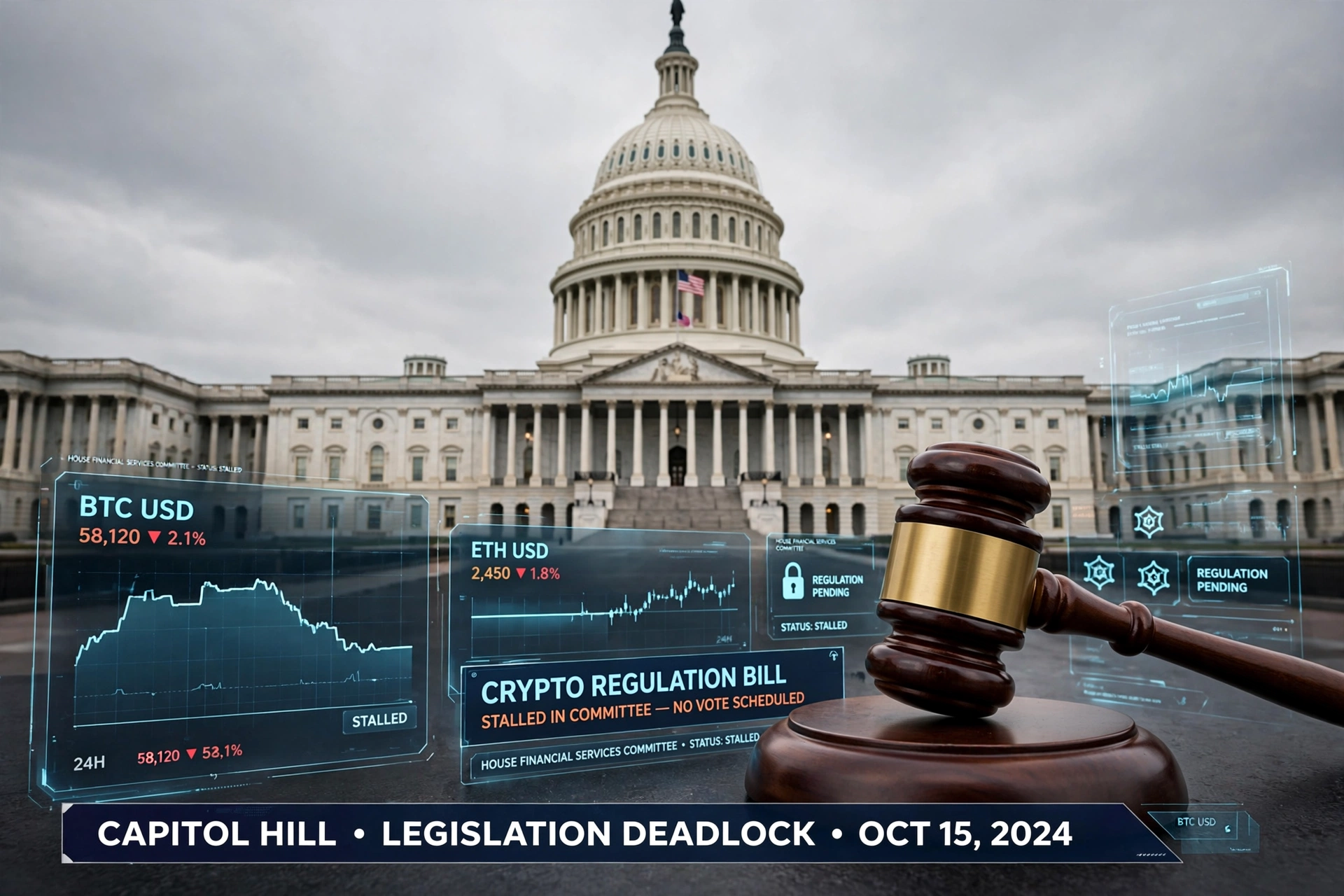
The effort to give the United States its first comprehensive framework for cryptocurrency markets has hit another delay, just as a key White House voice on digital assets steps away. Patrick Witt is leaving his White House crypto role while the CLARITY Act, the market-structure bill meant to divide oversight between regulators, remains stalled in the Senate. For exchanges, token issuers and banks waiting for legal certainty, the combination of a leadership change and a legislative pause leaves the most important questions in US crypto policy unanswered for longer.
The CLARITY Act, formally the Digital Asset Market Clarity Act, passed the House with bipartisan support and was presented as a way to end years of regulation by enforcement. Its progress in the Senate has been slower, with committees still working through how to treat decentralised finance, stablecoin yield, ethics provisions and the balance of power between the Securities and Exchange Commission and the Commodity Futures Trading Commission. Readers tracking technology and regulation coverage can follow related reporting on TechLawNews.
Why the CLARITY Act Matters
At its core, the bill tries to answer a simple question that US courts and regulators have contested for a decade: when is a digital asset a security, when is it a commodity, and which agency supervises the markets where it trades? The text of the House bill is available from Congress.gov, and industry coverage of the Senate debate has been tracked closely by CoinDesk. A clear answer would shape listing decisions, compliance budgets and whether new products are launched in the United States or offshore.
Supporters argue that without a statute, the US risks losing developers and trading activity to jurisdictions that have already written bespoke crypto regimes. Critics, including some Senate Democrats and investor-protection groups, warn against locking in definitions that could weaken securities laws or create loopholes for platforms that handle customer funds. Those competing concerns help explain why a bill that moved quickly in the House has become a slower, more technical negotiation in the Senate.
What Witt’s Departure Changes
Leadership changes rarely kill legislation on their own, but they can change momentum. A White House crypto adviser helps coordinate the administration’s position, answers technical questions from congressional staff and signals to agencies how hard the president wants a deal. Witt’s departure, discussed widely in crypto communities including r/CryptoCurrency, raises questions about who will carry that coordinating role while the Senate talks continue, and whether crypto remains near the top of a crowded legislative agenda.
It also matters for timing. Congress faces competing priorities, from government funding to other financial-services measures, and bills that lose their champions can drift. Market participants say even a short delay has practical effects: firms postpone US launches, keep legal teams on standby and build products to satisfy the strictest plausible interpretation of existing law, rather than the clearer regime the bill promises.
Compliance in a Holding Pattern
For compliance officers, the stall does not mean the rules disappear. Existing securities, commodities, money-transmission and anti-money-laundering obligations continue to apply, and regulators retain the enforcement tools they have used in recent years. Lawyers advising exchanges typically recommend documenting classification analysis for each listed asset, strengthening custody and conflicts controls, and preparing for either outcome in the Senate: a negotiated market-structure law, or another Congress in which the current patchwork persists.
Banks and payment firms face a similar calculation. Stablecoin legislation has already given some institutions more confidence to offer custody and payment services, but questions about trading venues, DeFi interfaces and tokenised securities remain open. A stalled CLARITY Act keeps those business lines in a cautious phase, with investment approved in stages rather than at scale.
What Happens Next in the Senate
The bill’s path now depends on committee work and on whether negotiators can resolve the issues that have slowed it: how to regulate DeFi without imposing impossible duties on software developers, how to handle illicit-finance controls, and how ethics rules should apply to public officials’ crypto interests. If a compromise emerges, the Senate could still move a version that then has to be reconciled with the House text. If talks break down, supporters may try to attach narrower provisions to other legislation.
For investors, the immediate lesson is not that US regulation has been abandoned, but that its timetable has slipped again. Prices have often reacted more to regulatory headlines than to the slow detail of committee drafting, yet it is that detail that will determine costs and opportunities for years. Until the Senate acts and a successor settles into the White House crypto role, the industry remains where it has been for some time: operating at scale in the world’s largest capital market, while still waiting for Congress to say, in law, exactly how that market should work.
