

Manufacturers in hygienic and sanitary industries face many of the same fundamental challenges: maintaining product quality, controlling contamination risks, improving process consistency, and making efficient use of production space. At the same time, every facility has its own requirements based on the products it makes, its regulatory environment, existing equipment, and production goals.
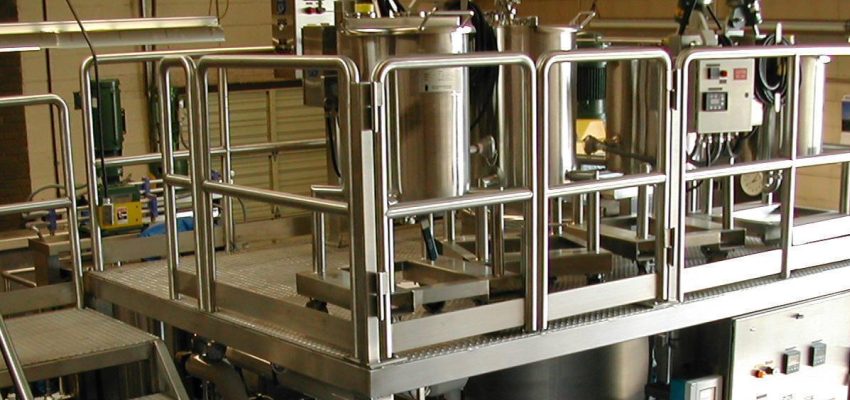
Hygienic processing skids offer manufacturers a flexible way to address these challenges. By integrating pumps, valves, instrumentation, heat exchangers, piping, controls, and other equipment onto a common frame, skid-mounted systems can provide a compact, engineered solution for a specific processing function.
Applications can range from relatively straightforward ingredient-dosing or product-transfer systems to sophisticated clean-in-place (CIP), mixing, filtration, heating, cooling, and high-purity processing systems.
Why Manufacturers Use Skid-Mounted Process Systems
One of the primary advantages of a process skid is that much of the system can be assembled and tested before it arrives at the manufacturing facility.
Traditional process installations may require significant field fabrication and coordination between multiple trades. A skid-mounted system moves much of that work into a controlled fabrication environment. Depending on the project, equipment can be mounted, piping fabricated, instrumentation installed, controls integrated, and portions of the system tested before shipment.
This approach can help reduce on-site installation requirements and minimize disruption to active production areas. It also allows manufacturers to inspect and test systems before installation through processes such as factory acceptance testing (FAT).
For hygienic applications, skid design also provides an opportunity to consider cleanability, drainability, accessibility, material selection, instrumentation, and process control as part of an integrated system rather than treating each component independently.
Companies such as Central States Industrial engineer and fabricate hygienic process skids for applications across multiple processing industries.
Food Processing
Food manufacturers handle an enormous range of products, from sauces and dressings to baked goods, nut products, meat and poultry, spreads, and prepared foods. Each application can introduce different processing requirements based on viscosity, temperature, particulates, allergens, sanitation needs, and production volume.
Skid-mounted systems can support functions such as mixing and blending, ingredient addition, filtration, heating and cooling, product transfer, pasteurization, and CIP.
A sauce manufacturer, for example, may need a system capable of accurately dosing ingredients and maintaining consistent recipes while also providing an effective cleaning cycle between production runs. Other processors may require filtration systems for incoming ingredients or heating systems designed to bring products to specific processing temperatures.
Because the system is engineered around the application, equipment and controls can be selected to accommodate the product’s characteristics rather than forcing the process into a standardized configuration.
Dairy Processing
Dairy facilities place particularly high demands on sanitary equipment because products are sensitive to both microbial contamination and processing conditions.
Milk, yogurt, cheese products, cultured dairy products, and ice cream may require carefully controlled heating, cooling, pumping, mixing, and cleaning operations. Hygienic skid systems can integrate these functions into purpose-built processing modules.
High-temperature, short-time (HTST) pasteurization is one example. An HTST skid may combine pumps, heat exchangers, holding tubes, valves, instrumentation, and automated controls to maintain required time and temperature conditions.
Skids can also support dairy applications such as yogurt transfer, ingredient blending, CIP, and other sanitary fluid-handling operations.
Beverage and Brewing
Consistency is critical in beverage manufacturing and brewing. Ingredients must be transferred and blended accurately while processors maintain control over temperature, flow, pressure, and other process conditions.
Processing skids can be used for syrup delivery, ingredient dosing, blending, filtration, product transfer, gas management, CIP, and thermal processing.
Automation can provide another important advantage. Instruments monitoring variables such as flow, temperature, level, and pressure can communicate with system controls to improve repeatability and give operators better visibility into process conditions.
For growing beverage manufacturers and breweries, modular systems can also provide a practical way to add production capacity without redesigning an entire processing area.
Biopharmaceutical and High-Purity Manufacturing
Biopharmaceutical and pharmaceutical facilities introduce additional requirements for hygienic system design, fabrication quality, documentation, and process validation.
Skid-mounted systems may support applications including water-for-injection (WFI) and purified water distribution, filtration, separation, buffer preparation, CIP, steam-in-place (SIP), biowaste inactivation, and heating or cooling.
In these environments, the physical system is only part of the project. Material traceability, weld documentation, inspection records, testing, controls, and other documentation may be necessary to demonstrate that the equipment meets project and facility requirements.
CSI has designed and fabricated systems for high-purity applications ranging from WFI distribution and pharmaceutical filtration to water treatment and centralized CIP.
Home and Personal Care Manufacturing
Products such as shampoos, lotions, deodorants, cosmetics, cleaning products, and other personal or household formulations can present their own processing challenges.
Some products are viscous, temperature-sensitive, or dependent on precise ingredient addition. Others require frequent recipe changes or careful control of fragrances, colors, and other additives.
Custom skids can combine mixing, pumping, heating, cooling, filtration, and dosing equipment into a configuration tailored to the formulation and production process.
They can also be engineered around physical facility constraints. For manufacturers operating within an existing plant, the ability to design equipment to fit a specific footprint is especially valuable when floor space or access is limited.
Chemical and High-Acid Processing
Hygienic processing principles also apply to chemical and high-acid applications, particularly when product purity, corrosion resistance, controlled transfer, or effective cleaning are important.
In these environments, material compatibility becomes a major design consideration. The correct stainless steel or corrosion-resistant alloy must be selected based on the chemistry, temperature, concentration, and other operating conditions involved.
Pumps, seals, valves, instrumentation, and piping must likewise be evaluated as parts of the complete system. A component that performs well in one application may have a significantly shorter service life when exposed to a more aggressive process fluid.
Building a System Around the Process
Although hygienic processing skids are used across many industries, successful systems share an important characteristic: they are designed around the process they need to perform.
Product characteristics, flow rates, temperatures, pressures, cleaning requirements, available space, automation needs, regulatory expectations, and maintenance access can all influence the final configuration.
That makes early collaboration between processors, engineers, equipment specialists, and fabricators important. Evaluating these factors before fabrication can help identify potential problems while changes are still relatively easy to make.
A well-designed skid is ultimately more than a collection of sanitary components mounted on a frame. It is an integrated processing system designed to perform a defined function reliably, cleanly, and consistently.
As manufacturers seek to increase capacity, automate production, improve sanitation, or modernize existing facilities, hygienic processing skids offer a flexible approach adaptable to the needs of industries ranging from food and dairy to biopharmaceuticals and personal care.
