

Industrial facilities often require continuous cooling for manufacturing processes, equipment, air conditioning, and temperature-sensitive operations. At the same time, many industrial processes generate low-grade heat that is rejected into the atmosphere or removed through conventional cooling systems. This creates an opportunity to recover otherwise unused thermal energy and convert it into useful cooling.
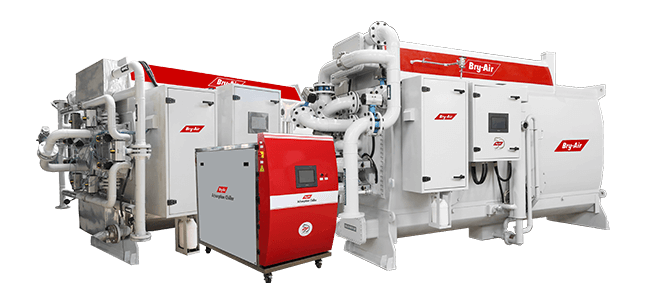
Adsorption chillers provide a technology-driven approach to this challenge. Instead of depending primarily on electricity to operate a conventional mechanical refrigeration cycle, adsorption cooling can use suitable waste heat, solar heat, or other thermal energy sources to produce chilled water. Bry-Air’s adsorption chiller technology uses a silica gel and water combination and is designed for applications where low-grade heat and cooling demand are available at the same facility.
What Is an Adsorption Chiller and How Does It Work?
An adsorption chiller is a thermally driven cooling system that uses an adsorbent material and a refrigerant to generate chilled water. The technology works through the interaction between a solid adsorbent and a refrigerant vapour. In Bry-Air’s system, specially developed silica gel serves as the adsorbent while water functions as the refrigerant.
The system operates under vacuum conditions. When water evaporates at low pressure, it absorbs heat from the chilled water circuit, creating the cooling effect. The water vapour is then adsorbed by the silica gel. A separate chamber is regenerated using hot water, which releases the absorbed vapour and allows the cycle to continue. Bry-Air describes its adsorption chiller as having an evaporator, condenser, and two adsorption chambers that alternate between adsorption and desorption.
How the Adsorption Cycle Produces Chilled Water
The cooling cycle begins when refrigerant water evaporates in the evaporator under low-pressure conditions. The resulting water vapour moves toward one adsorption chamber, where it is captured by the silica gel. The heat generated during adsorption is removed through circulating cooling water.
While one chamber is adsorbing water vapour, the second chamber undergoes regeneration. Hot water supplies the thermal energy required to release the previously adsorbed vapour from the silica gel. The released vapour travels to the condenser, where it returns to liquid water before being recycled through the system.
The two chambers periodically change roles. This alternating operation enables continuous chilled water production while the available thermal energy drives the regeneration process. Bry-Air specifies nominal operating conditions around 90°C hot water, 24°C to 35°C cooling water, and chilled water output within a range suitable for process cooling and HVAC applications.
Why Is Waste Heat Important for Industrial Cooling?
Industrial processes frequently generate heat as a natural part of production and energy conversion. Sources can include steam generation, power generation, process heating, furnaces, compressors, engines, and other equipment. In many facilities, this thermal energy is ultimately rejected rather than recovered for another useful purpose.
Adsorption cooling creates an opportunity to use this available heat as the driving energy for refrigeration. Bry-Air identifies low-grade process heat in the approximate range of 50°C to 100°C as a potential source for its adsorption chiller technology. The company also identifies solar heat and other suitable thermal sources as possible driving energy.
Converting Rejected Heat Into Useful Cooling
The fundamental advantage of waste heat recovery is that the same facility can potentially use energy that would otherwise be discarded. Instead of generating all cooling through electricity, a suitable thermal energy stream can be directed toward an adsorption chiller to produce chilled water.
The effectiveness of this approach depends on the characteristics of the available heat source. Temperature, flow rate, availability, operating schedule, and cooling demand all influence whether an adsorption chiller is technically appropriate. A proper engineering assessment should therefore be completed before selecting equipment or designing a heat recovery system.
What Are the Main Benefits of Adsorption Chillers?
Adsorption chillers can provide several advantages when properly integrated into an industrial cooling system. Bry-Air highlights ultra-low electricity consumption, low noise and vibration, low maintenance requirements, long operating life, and the use of water as the refrigerant among the key characteristics of its technology.
Lower Electrical Consumption
Because thermal energy drives the primary adsorption and desorption process, the system does not require the same level of electrical energy associated with conventional compressor-driven refrigeration. Electricity is still required for components such as pumps, controls, and auxiliary equipment, but the main cooling cycle is thermally driven.
This characteristic can be particularly valuable in facilities where cooling represents a significant electrical load and a reliable source of suitable waste heat is already available. The actual energy savings will depend on operating conditions, heat availability, cooling requirements, and the design of the overall system.
Water as the Refrigerant
Another important characteristic is the use of water as the refrigerant. Bry-Air describes its silica gel and water combination as an advanced green technology. Water does not present the same ozone depletion and global warming concerns associated with many conventional refrigerants, making it an important consideration for organizations focused on environmentally responsible cooling technologies.
Low Noise and Reduced Mechanical Complexity
Adsorption chillers operate with relatively few moving parts in the adsorption process. Bry-Air states that its systems operate with negligible noise and vibration, which can be beneficial in facilities where acoustic performance and equipment reliability are important considerations.
Long Operating Life
Bry-Air states that its adsorption chiller technology has a life expectancy of more than 25 years. A long equipment life can contribute to a favorable lifecycle assessment when the system is correctly selected, installed, operated, and maintained. Actual service life will depend on water quality, operating conditions, controls, installation practices, and maintenance procedures.
How Should Businesses Select the Right Adsorption Chiller?
Selecting an adsorption chiller requires more than simply matching the required cooling capacity. The available thermal energy must be evaluated alongside the cooling requirement to determine whether the system can operate efficiently under actual site conditions.
Organizations evaluating this technology should consider the heat source temperature, available heat quantity, chilled water requirements, cooling water conditions, operating hours, process load, and integration with existing HVAC or process cooling infrastructure. Working with experienced adsorption chiller manufacturers can help ensure that these technical factors are evaluated before equipment selection.
Assess the Available Heat Source
The heat source is one of the most important factors in adsorption chiller selection. A facility should establish the temperature profile, flow rate, availability, and consistency of its recoverable heat before determining the appropriate system configuration.
Bry-Air identifies several possible sources of low-grade heat, including power generation, fuel-fired furnaces, process heating, air compressors, diesel and gas engines, and other industrial processes.
Match Cooling Capacity to Actual Demand
Bry-Air’s desiccant adsorption chiller range is stated as 35 kW to 1,180 kW, equivalent to approximately 10 TR to 335 TR. This range allows the technology to be considered across different industrial and commercial cooling requirements.
However, selecting capacity should be based on the actual cooling load rather than maximum possible demand alone. Load profiles, seasonal requirements, process schedules, chilled water temperatures, and future expansion should all be evaluated as part of the engineering process.
Where Can Adsorption Chillers Be Used?
Adsorption chillers can be considered across industries where recoverable thermal energy and cooling requirements exist together. Bry-Air identifies applications in chemical manufacturing, power generation, food and beverages, automobile manufacturing, aluminium, pulp and paper, sugar, gas pipelines, general industry, and other industrial sectors.
Process Cooling and HVAC Applications
The chilled water generated by an adsorption chiller can be used for industrial process cooling or air conditioning. This flexibility makes the technology relevant to both manufacturing environments and commercial HVAC systems where suitable heat sources are available.
For process applications, engineers should evaluate the required chilled water temperature and flow rate along with the process load. For HVAC applications, the assessment should include building cooling demand, operating schedules, existing chilled water infrastructure, and the available thermal energy source.
Can Adsorption Chillers Support Sustainable Cooling?
Energy efficiency and waste heat recovery are increasingly important components of industrial sustainability strategies. An adsorption chiller can support these objectives by converting suitable thermal energy that might otherwise be rejected into useful cooling.
Bry-Air positions its adsorption chiller technology as an energy-smart cooling solution that can reduce electrical cooling requirements and make better use of low-grade heat. Its product information also highlights the potential for lower carbon emissions through the recovery and utilization of waste heat.
However, sustainability performance should always be evaluated using site-specific data. The environmental and financial benefits will depend on the source of the recovered heat, operating conditions, cooling demand, existing equipment, energy prices, and the overall system design.
Conclusion
Adsorption chillers offer a practical approach to industrial cooling by using suitable waste heat or other thermal energy sources to generate chilled water. Their silica gel and water technology enables cooling without relying primarily on electrically driven compression, while the use of water as the refrigerant supports environmentally conscious system design.
The technology can be particularly valuable for facilities that simultaneously generate low-grade waste heat and require process cooling or HVAC cooling. Bry-Air’s adsorption chillers cover a broad capacity range and are designed for applications across multiple industrial sectors.
For organizations considering this technology, the most important step is to evaluate the available heat source, cooling load, temperature requirements, operating hours, and system integration requirements. A technically appropriate design can help transform otherwise unused thermal energy into productive cooling while supporting broader energy-efficiency objectives. Businesses interested in evaluating their cooling requirements can Contact Us to discuss their application and explore an appropriate adsorption cooling solution.
