

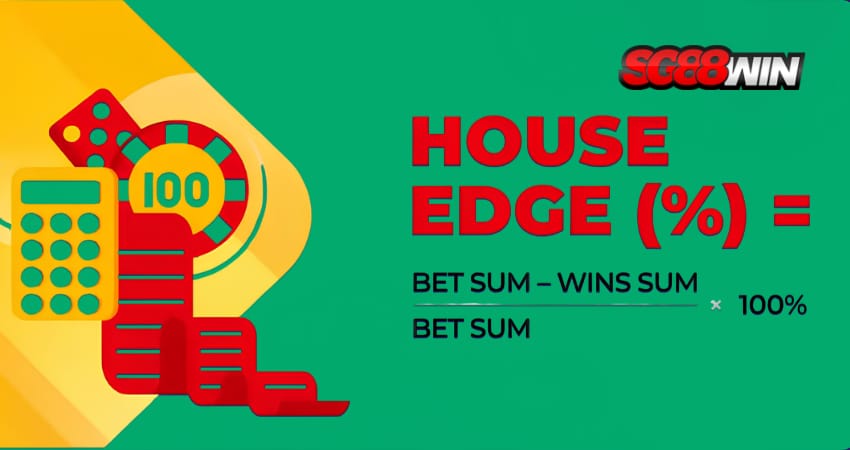
A 5% house edge doesn’t mean you’ll lose exactly $5 every single time you wager $100 — it’s a long-term average, not a per-bet guarantee. Some games are built with a house edge under 1%. Others sit above 5%. Knowing the difference — and why it exists — is one of the simplest ways to stretch your budget further on SG88WIN, whether you’re at a blackjack table or spinning slots.
What is the House Edge?
The house edge, put plainly, is the advantage a casino designs into the game from the start. It’s shown as a percentage of everything wagered, and it only actually reveals itself once you’re looking at a huge volume of bets — not just a handful.
A 5% house edge means the casino expects to keep $5 for every $100 wagered — but only once you zoom out across thousands or millions of bets, not any single one of yours.
How the Math Actually Plays Out
Say you wager $500 total on a game with a 4% house advantage, and the math says:
Wager $500 on a game with a 4% house advantage, and the math says: $500 x 4% = $20. That’s the theoretical edge against that volume of betting, not a guaranteed $20 loss from your balance. You could walk away $100 up or $70 down; the house edge would still be operating exactly as designed.
How Two Players End Up with Totally Different Outcomes
Put two players in front of the same game, each wagering $500, and their results can look nothing alike — one might walk away with $750, the other down $250.
That gap between them is just variance. Give it enough sessions, and the house edge starts to show through.
House Edge Across Popular Games
No single house edge applies across every casino game — and even inside one game, that number can shift based on the specific bet you make.
| Game or Bet | Typical House Edge |
| Baccarat — Banker | About 1.06% |
| Baccarat — Player | About 1.24% |
| European Roulette | About 2.70% |
| American Roulette | About 5.26% |
| Blackjack | Often under 1% with favorable rules and optimal play |
| Slots | Varies by individual game |
These are typical figures, not fixed values — always check the specific game’s rules and paytable on SG88WIN before comparing percentages directly.
Why Blackjack’s Edge Isn’t One Fixed Number
The game name alone doesn’t tell you much. The actual edge shifts from table to table based on things like the blackjack payout ratio, how many decks are in play, the dealer’s rule on soft 17, and any restrictions on doubling. Basic blackjack strategy helps close that gap too, though it reduces the house’s advantage rather than erasing it.
Why the Extra Zero in American Roulette Matters
If you’re playing European roulette, you’re looking at 37 pockets — numbers 1 through 36, plus a single zero — for a house edge around 2.70%. Switch to American roulette, and you’ve got a second zero added in, bringing it to 38 pockets and pushing the edge up to roughly 5.26%. One extra pocket sounds minor, but it nearly doubles the house’s advantage against you over repeated bets.
Does the Bet Type Itself Change the Edge?
A lot of people treat “baccarat” like it’s one bet with one set of odds. It’s not. Banker runs about a 1.06% edge, with Player just slightly higher at 1.24% (the gap between them isn’t huge). Tie holds a very high house advantage — approximately 14%.
And if you’ll bet on Tie repeatedly, it’ll cost you far more over time than sticking to Banker or Player, even though all three are technically “baccarat bets” at the same table.
You’re sitting at a baccarat table on SG88WIN. That alone doesn’t tell you much about your odds — it comes down to which bet you actually place: Banker, Player, or Tie. Each one carries its own house edge, even though they’re all technically the same game.
House Edge vs. RTP: What’s the Difference?
They’re describing the same math from opposite directions. RTP tells you what a game pays back over time; house edge tells you what it keeps. Subtract RTP from 100%, and you get the house edge — a 96% RTP slot runs on roughly a 4% house edge, a 98% RTP slot on about 2%.
Does a Lower House Edge Guarantee a Better Session?
No — it just means the long-run disadvantage is smaller, not that any single session goes your way. Someone can lose fast at a low-edge game purely from bad variance, while someone else walks away up big at a high-edge game in the same amount of time. Knowing the house edge won’t predict what happens to you today. What it does is tell you the actual math you’re playing against before you sit down.
Before You Play
The house edge doesn’t predict whether your next session wins or loses — it just tells you what the game is mathematically asking of you over time. Before playing on SG88WIN, check the specific bet, its rules, and the RTP or house edge, rather than judging a game by its payout alone.
FAQs:
Does the House Edge Matter If I Only Play for a Short Time?
It still describes the math you’re playing against, even if a short session won’t reflect it clearly. A handful of wins or losses can easily outweigh the theoretical edge in the moment.
Does a Bigger Bet Increase the Effect of the House Edge?
The percentage stays fixed either way. What changes is the dollar amount it represents — at a 4% edge, $100 wagered theoretically costs $4, while $1,000 wagered theoretically costs $40.
Does the Number of Blackjack Decks Change the House Edge?
Yes, though the size of that effect depends on the other table rules too. Deck count alone isn’t enough to compare two blackjack tables fairly.
